BIM Standards: 9 Essential Guidelines Every Construction Professional Should Know
Learn everything about BIM Standards, including ISO 19650, COBie, Level of Development, national BIM standards, benefits, implementation strategies, and best practices for modern construction projects.
2/10/20253 min read
Introduction
Building Information Modeling (BIM) has transformed the architecture, engineering, and construction (AEC) industry. However, BIM can only work effectively when everyone follows a common set of rules and procedures. That is where BIM Standards become essential.
BIM standards provide guidelines for creating, managing, sharing, and maintaining digital construction information. They help project teams collaborate efficiently, reduce errors, and improve project quality.
Without proper BIM standards, different stakeholders may use inconsistent naming systems, file formats, or workflows, leading to confusion and delays.
What Are BIM Standards?
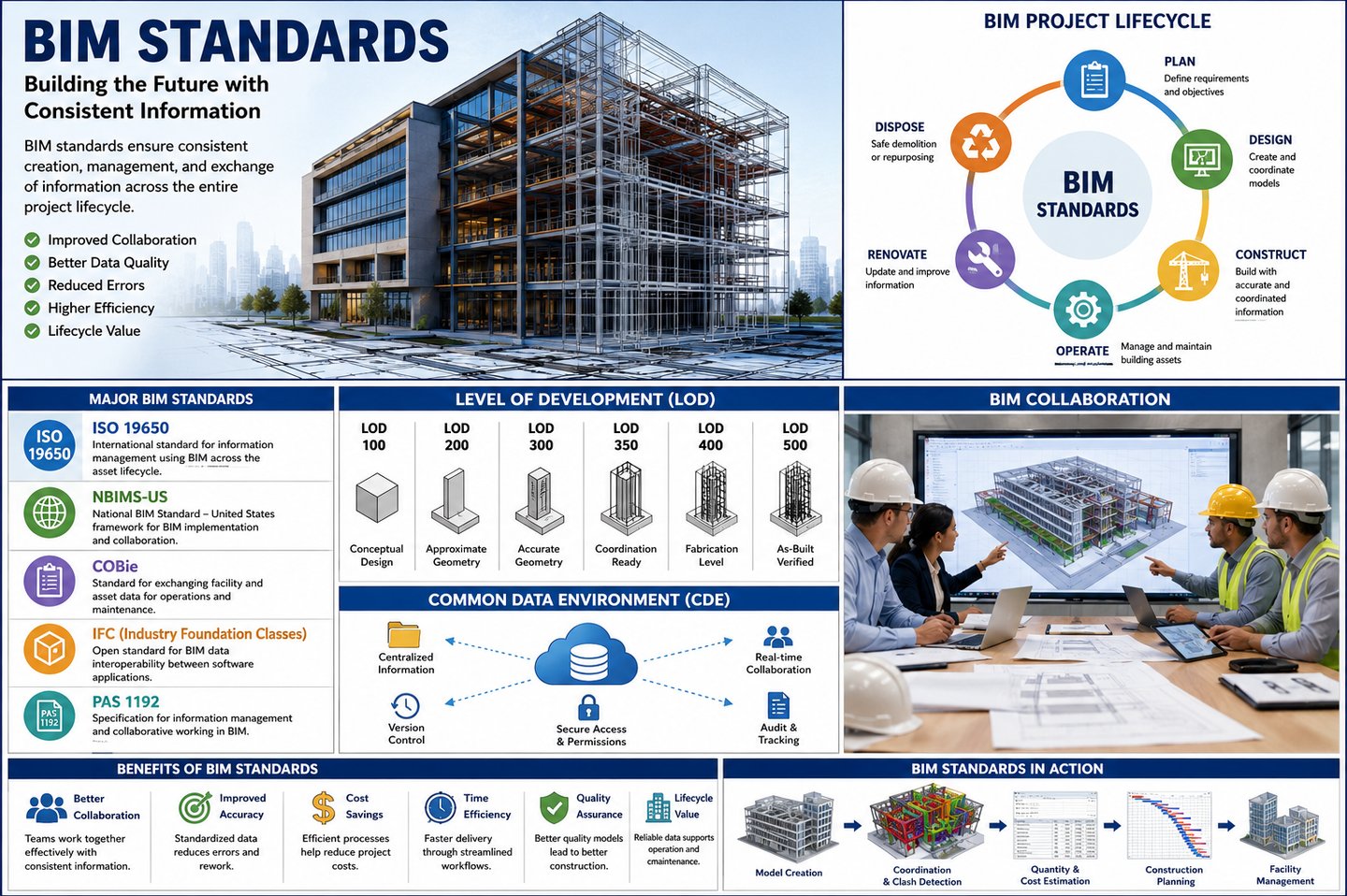
BIM Standards are structured guidelines and protocols that define how BIM data should be created, organized, exchanged, and managed during a project lifecycle.
These standards ensure:
Consistent project information
Better collaboration
Accurate data exchange
Improved project quality
Reduced errors and conflicts
BIM standards are used by:
Architects
Engineers
Contractors
Facility managers
Government agencies
Infrastructure developers
Why BIM Standards Are Important
1. Improved Collaboration
Standardized workflows help teams communicate effectively across disciplines.
2. Better Data Management
Consistent data structures make information easier to access and maintain.
3. Reduced Project Errors
Clear standards minimize misunderstandings and coordination issues.
4. Enhanced Productivity
Teams spend less time fixing file compatibility problems.
5. Global Project Compatibility
International standards allow companies to work across countries and organizations.
Key Components of BIM Standards
ComponentPurposeNaming ConventionsStandard file and model namingData Exchange FormatsEnsures software compatibilityModel StructureDefines organization of BIM modelsLevel of Development (LOD)Specifies model detail requirementsCollaboration ProceduresStandardizes team workflowsDocumentation StandardsEnsures consistent reporting
Major International BIM Standards
1. ISO 19650
International Organization for Standardization developed ISO 19650 as the leading international BIM standard.
What Is ISO 19650?
ISO 19650 provides guidelines for managing information throughout the lifecycle of a built asset using BIM.
Key Features
Standardized information management
Collaborative workflows
Common Data Environment (CDE)
Risk management procedures
Asset lifecycle management
Benefits of ISO 19650
Better global collaboration
Improved data consistency
Reduced project risks
Enhanced information security
Learn more at
ISO 19650 Overview
2. National BIM Standard (NBIMS-US)
The National BIM Standard is widely used in the United States construction industry.
Objectives
Standardize BIM implementation
Improve interoperability
Support lifecycle data management
Main Focus Areas
Information exchange
Model organization
Project collaboration
Open standards integration
3. COBie (Construction Operations Building Information Exchange)
COBie is a structured format used for transferring facility management information.
Purpose of COBie
COBie helps building owners receive organized digital information for operations and maintenance.
Typical COBie Data
Equipment details
Maintenance schedules
Warranty information
Asset tracking records
COBie is commonly required for government and public-sector projects.
4. IFC (Industry Foundation Classes)
IFC is an open file format used for BIM data exchange between different software applications.
Why IFC Matters
Different BIM software programs may not always communicate perfectly. IFC solves this interoperability issue.
Advantages
Open-standard compatibility
Long-term data preservation
Software-independent collaboration
5. PAS 1192
Before ISO 19650, PAS 1192 was the primary BIM standard in the UK.
It established:
Information management procedures
Collaborative workflows
Common data environments
Many ISO 19650 principles originated from PAS 1192.
BIM Levels Explained
Level 0 BIM
Basic 2D CAD drafting with limited collaboration.
Level 1 BIM
Combination of 2D and 3D information with standardized data structures.
Level 2 BIM
Collaborative BIM with shared models and coordinated workflows.
Level 3 BIM
Fully integrated cloud-based BIM collaboration.
Level of Development (LOD) Standards
LOD defines the amount of detail and reliability in a BIM model.
LOD LevelDescriptionLOD 100Conceptual designLOD 200Approximate geometryLOD 300Accurate geometryLOD 350Coordination-ready modelLOD 400Fabrication-level detailLOD 500As-built verified model
Common Data Environment (CDE)
A Common Data Environment is a centralized platform for storing and sharing project information.
Benefits of CDE
Real-time collaboration
Version control
Improved data security
Reduced duplication
Popular CDE platforms include:
Autodesk Construction Cloud
Bentley ProjectWise
Trimble Connect
BIM Standards in Different Countries
United Kingdom
The UK strongly supports ISO 19650 implementation.
United States
NBIMS-US and COBie are commonly used.
Singapore
Singapore mandates BIM for many large-scale projects.
India
India is rapidly adopting BIM standards for smart city and infrastructure projects.
European Union
Many EU countries are integrating BIM into public construction procurement.
Challenges in BIM Standard Adoption
Lack of Training
Many professionals still require BIM education.
Software Compatibility
Different tools may create interoperability issues.
High Initial Costs
Implementing BIM systems can require major investment.
Resistance to Change
Some organizations still rely on traditional workflows.
Best Practices for Implementing BIM Standards
Develop a BIM Execution Plan (BEP)
A BEP defines project-specific BIM workflows and responsibilities.
Use Open Standards
Adopt formats like IFC for better interoperability.
Provide Team Training
Continuous BIM education improves adoption success.
Maintain Data Quality
Regular audits ensure model accuracy and consistency.
Use Cloud Collaboration Platforms
Cloud-based systems improve accessibility and coordination.
Future of BIM Standards
The future of BIM standards is closely connected to digital transformation technologies.
Artificial Intelligence
AI will automate model checking and data analysis.
Digital Twins
Live digital replicas of buildings will rely heavily on BIM standards.
Smart Cities
BIM standards will support integrated urban infrastructure systems.
Blockchain Integration
Blockchain may improve project transparency and data security.
Frequently Asked Questions (FAQs)
What are BIM Standards?
BIM standards are guidelines that define how building information should be created, managed, and exchanged.
Why are BIM Standards important?
They improve collaboration, reduce errors, and ensure consistent project information.
What is ISO 19650?
ISO 19650 is the international standard for BIM information management.
What is IFC in BIM?
IFC is an open file format that enables BIM software interoperability.
What is COBie used for?
COBie transfers building asset information for facility management.
What is LOD in BIM?
LOD stands for Level of Development and defines model detail accuracy.
Conclusion
BIM Standards are essential for successful digital construction projects. They provide a structured framework that improves communication, collaboration, and information management across the entire project lifecycle.
As construction projects become more complex and technology-driven, BIM standards will continue to play a critical role in ensuring efficiency, accuracy, and long-term project success.
Organizations that adopt BIM standards today are preparing themselves for the future of smart construction and digital infrastructure.