What Is BIM? 7 Powerful Benefits of Building Information Modeling
Learn what BIM is, how Building Information Modeling works, its benefits, uses in construction, and why BIM is transforming the architecture, engineering, and construction industry.
5/10/20263 min read
Introduction
Building Information Modeling, commonly known as BIM, is one of the most important technologies in the modern construction and architecture industry. It has completely changed how buildings and infrastructure projects are planned, designed, built, and maintained.
In simple words, BIM is a digital process that creates intelligent 3D models containing detailed information about a building project. These models help architects, engineers, contractors, and project owners collaborate more efficiently.
Instead of relying only on traditional 2D drawings, BIM allows teams to visualize every part of a project before construction even begins. This reduces errors, improves communication, and saves both time and money.
What Does BIM Stand For?
BIM stands for Building Information Modeling.
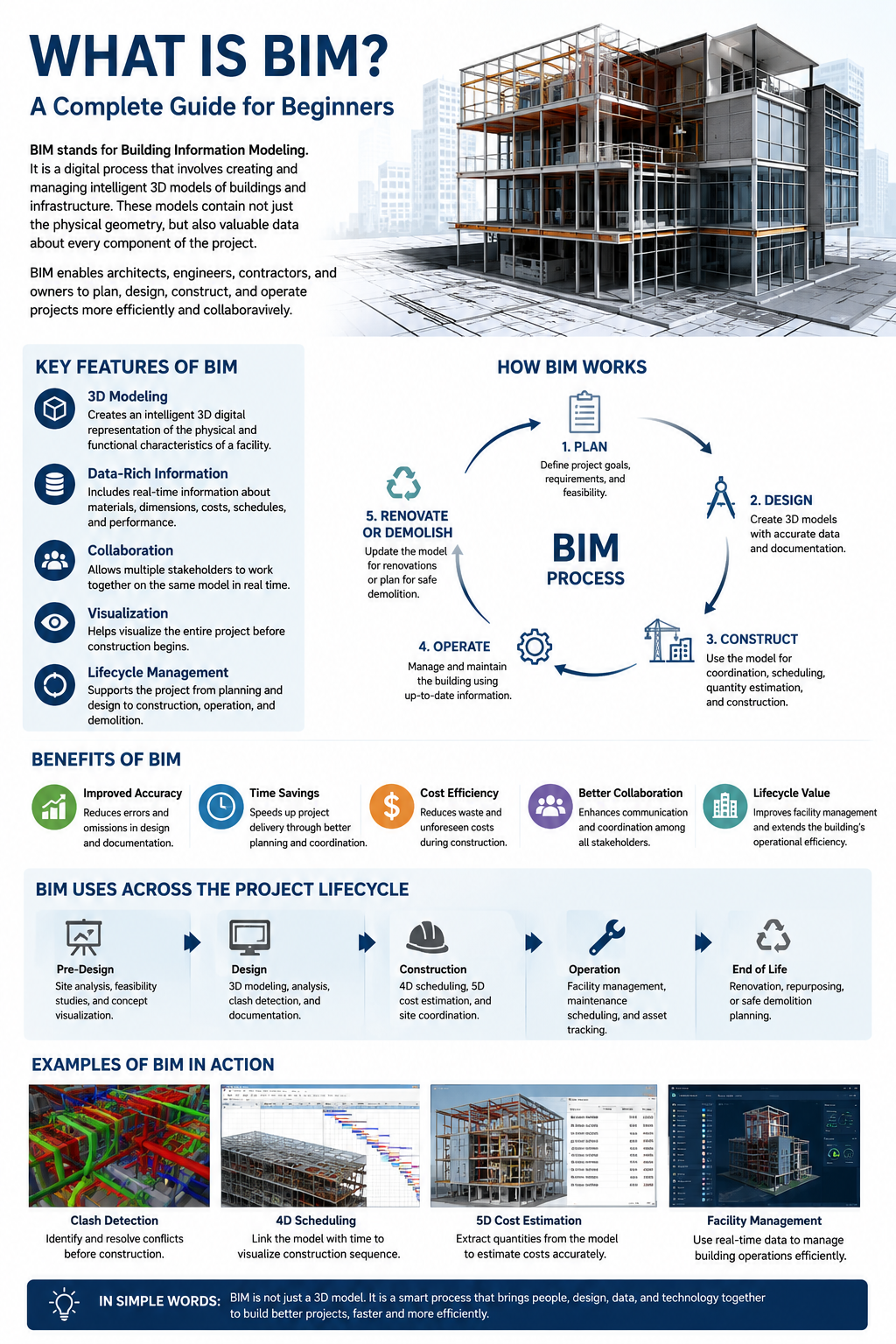
It is a smart digital representation of the physical and functional characteristics of a building or infrastructure project. BIM is not just software—it is a complete process for managing project information throughout the entire building lifecycle.
This lifecycle includes:
Planning
Design
Construction
Operation
Maintenance
Renovation or demolition
How BIM Works
BIM works by creating a shared digital model that all project stakeholders can access and update in real time.
Key Components of BIM
ComponentDescription3D ModelingCreates realistic digital building modelsData IntegrationAdds information like materials, costs, schedulesCollaborationAllows teams to work together efficientlySimulationTests building performance before constructionLifecycle ManagementTracks building data from start to finish
With BIM, every change made to the model automatically updates related drawings, schedules, and documents. This greatly reduces mistakes and confusion.
Types of BIM Dimensions
BIM is often categorized into dimensions that provide different levels of project information.
3D BIM
Focuses on visual modeling and geometry.
4D BIM
Adds scheduling and time-related information.
5D BIM
Includes cost estimation and budgeting.
6D BIM
Supports sustainability and energy analysis.
7D BIM
Helps with facility management and maintenance.
Main Features of BIM
1. Intelligent 3D Modeling
BIM creates highly detailed 3D digital models that represent real-world building components accurately.
2. Real-Time Collaboration
Multiple teams can work on the same project model simultaneously.
3. Clash Detection
BIM identifies conflicts between systems like plumbing, electrical, and structural elements before construction begins.
4. Accurate Quantity Takeoffs
BIM automatically calculates materials and quantities from the model.
5. Better Visualization
Clients and stakeholders can easily understand project designs using realistic visual models.
Benefits of BIM
Improved Project Efficiency
BIM streamlines workflows and reduces repetitive tasks.
Reduced Construction Errors
Clash detection minimizes costly mistakes during construction.
Better Cost Control
Accurate estimates help avoid budget overruns.
Enhanced Communication
Everyone involved in the project works from the same updated information.
Faster Project Delivery
Improved coordination speeds up project timelines.
Higher Quality Construction
BIM helps ensure designs are implemented correctly.
Long-Term Facility Management
Building owners can use BIM data for maintenance and operations after construction is complete.
Industries That Use BIM
BIM is widely used across several industries.
Architecture
Architects use BIM to create detailed building designs.
Engineering
Engineers analyze structural, electrical, and mechanical systems.
Construction
Contractors use BIM for planning and execution.
Infrastructure
BIM supports roads, bridges, railways, and airports.
Facility Management
Building managers use BIM for maintenance and operations.
Popular BIM Software
Several software platforms support BIM workflows.
SoftwarePrimary UseAutodesk RevitArchitectural BIM modelingNavisworksClash detection and coordinationArchiCADArchitectural designBentley SystemsInfrastructure projectsTekla StructuresStructural engineering
You can explore BIM standards and resources at
Autodesk BIM Overview
BIM vs Traditional CAD
FeatureBIMTraditional CADModelingIntelligent 3D models2D drawingsDataInformation-richLimited dataCollaborationReal-timeManual sharingUpdatesAutomaticManualLifecycle SupportYesLimited
Traditional CAD focuses mainly on drafting, while BIM focuses on complete project information management.
Challenges of BIM Implementation
Although BIM offers many benefits, some organizations face challenges when adopting it.
High Initial Cost
Software and training can be expensive initially.
Learning Curve
Teams need proper training to use BIM effectively.
Data Management
Managing large project data can be complex.
Standardization Issues
Different organizations may use different BIM standards.
Despite these challenges, the long-term benefits often outweigh the initial difficulties.
Future of BIM
The future of BIM looks extremely promising. New technologies are making BIM even more powerful.
Artificial Intelligence Integration
AI helps automate design optimization and analysis.
Cloud Collaboration
Teams can now work together remotely in real time.
Digital Twins
BIM models are evolving into live digital replicas of buildings.
Virtual and Augmented Reality
VR and AR improve visualization and training.
Smart Cities
BIM supports large-scale urban planning and infrastructure management.
Why BIM Matters in Modern Construction
Construction projects today are becoming more complex. BIM helps teams manage this complexity with better communication, planning, and coordination.
By reducing errors and improving efficiency, BIM saves organizations millions of dollars while delivering higher-quality buildings.
Governments around the world are also encouraging or mandating BIM use for public infrastructure projects.
Frequently Asked Questions (FAQs)
What is BIM in simple terms?
BIM is a digital process used to create and manage detailed 3D building models with project information.
Is BIM software or a process?
BIM is primarily a process, but it uses specialized software tools.
Who uses BIM?
Architects, engineers, contractors, project managers, and facility managers use BIM.
What are the main benefits of BIM?
Better collaboration, reduced errors, lower costs, and improved project efficiency.
What is the difference between BIM and CAD?
CAD focuses on drawings, while BIM includes intelligent building data and lifecycle management.
Can BIM reduce construction costs?
Yes. BIM helps detect issues early, reducing expensive mistakes and delays.
Conclusion
BIM, or Building Information Modeling, is revolutionizing the construction industry. It provides a smarter, faster, and more collaborative way to design, construct, and manage buildings and infrastructure projects.
As technology continues to evolve, BIM will become even more important in shaping the future of architecture, engineering, and construction.
Organizations that adopt BIM today are positioning themselves for greater efficiency, improved project quality, and long-term success.